Executive Summary
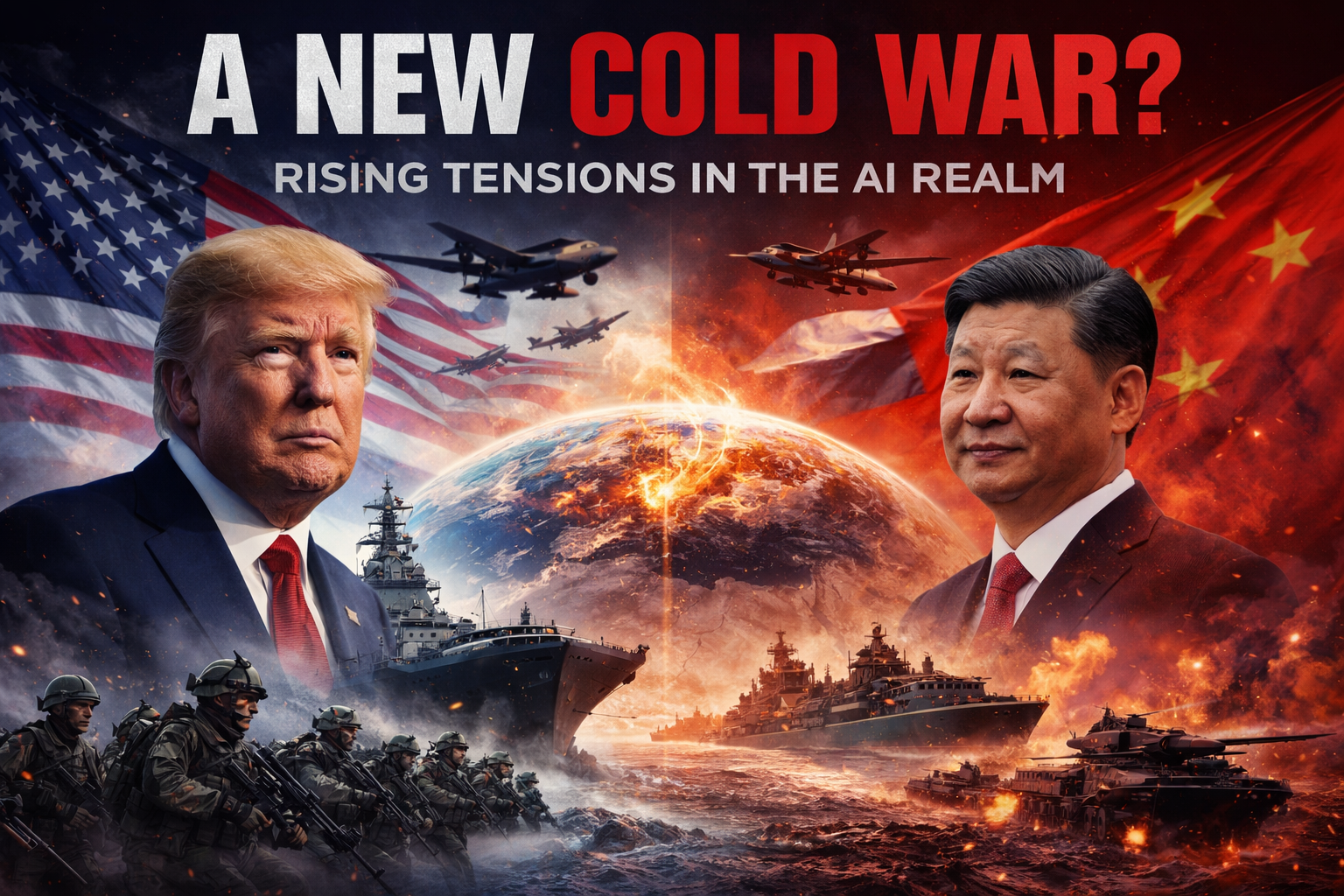
The U.S. and China are increasingly in an AI arms race, often framed as a new “AI Cold War.” In early 2025, a Chinese startup DeepSeek stunned global tech markets with its R1 AI model, which matched Western capabilities at a fraction of the cost. DeepSeek’s open-source approach highlights China’s strategy of open-source development, while the U.S. continues to rely on its established big tech firms. In response, U.S. officials have tightened export controls on advanced AI chips and raised security concerns. Most recently, OpenAI warned U.S. lawmakers that DeepSeek has been “distilling” outputs from leading U.S. models to train its own systems.
This article surveys the broader rivalry through three lenses: DeepSeek’s breakthroughs and China’s AI strategy; the U.S. policy response and debate over model distillation; and the larger question of whether “AI Cold War” is the right frame for understanding what is happening. The competition is real, but the subject is more nuanced than a simple geopolitical showdown.
U.S.–China Rivalry and the “AI Cold War” Concept
Discussion of an “AI Cold War” reflects growing U.S.–China tensions over advanced technology. Policymakers increasingly treat AI as a dual-use technology with both economic and military stakes. That has encouraged comparisons to the twentieth-century Cold War, especially in security and policy circles.
At the same time, the analogy has limits. The current AI landscape is not divided into two sealed ideological blocs. Talent, research, compute, capital, and open-source models move through global networks that are much more interconnected than the Cold War world. The phrase remains useful as a political metaphor, but it can oversimplify the reality of technological development.
DeepSeek and China’s AI Push
DeepSeek is a Chinese AI startup that burst into global attention in early 2025. Based in Hangzhou, it drew intense interest after releasing its R1 reasoning model. The company’s approach stood out because it leaned into open-source practices and published work in a way that resembled academic and engineering communities more than the closed commercial style of several Western frontier labs.
The R1 Shock
DeepSeek’s R1 model became a landmark moment because it appeared to deliver frontier-level reasoning at dramatically lower cost than many expected. The release challenged a widely held assumption in the AI industry: that only the most heavily funded American firms could sustain top-tier model performance.
The market reaction was immediate. DeepSeek’s arrival unsettled global tech investors and intensified debate over whether efficient engineering, model design, and inference optimization could narrow the gap between companies with different levels of capital and compute access.
Continued Iteration
After the success of R1, DeepSeek continued to refine its models. New updates improved reasoning quality, reduced error rates, and signaled an aggressive development pace. The company’s later releases also emphasized efficiency, long-context handling, and lower API pricing, reinforcing its identity as a cost-disruptive force in the AI market.
This matters beyond one company. DeepSeek became a symbol of China’s broader AI strategy: push quickly, iterate in public, use open models where possible, and compete on engineering efficiency rather than only on access to the very highest-end chips.
The U.S. Response
DeepSeek’s rise sharpened existing anxieties in Washington. The United States had already moved to restrict China’s access to advanced chips and semiconductor equipment, arguing that compute remains the decisive bottleneck in frontier AI. DeepSeek’s emergence complicated that picture by suggesting that algorithmic efficiency and model design might partly offset hardware constraints.
That does not mean compute no longer matters. It means the strategic landscape is becoming more complex. Restricting chips can slow progress, but it may not stop highly capable teams from finding alternative paths through optimization, distillation, and more efficient architectures.
Distillation and Strategic Friction
One of the most debated issues in this rivalry is model distillation. In machine learning, distillation can be a legitimate technique: a smaller model learns from the outputs of a larger one. But in geopolitical and commercial terms, distillation becomes controversial when firms believe their closed systems are being used to accelerate foreign competitors without authorization.
The DeepSeek episode pushed distillation into the center of public debate. That debate is not only about intellectual property. It is also about whether advanced AI safeguards, alignment methods, and capability gains can be copied faster than governments can regulate them.
Is This Really a Cold War?
There are good reasons people use the phrase. AI has become tied to national power, industrial policy, military planning, and long-term economic dominance. Both the United States and China want leadership in systems that may shape productivity, cyber capability, surveillance capacity, weapons development, and scientific discovery.
Still, the Cold War metaphor is incomplete. The Soviet-American rivalry was built around rigid blocs, minimal technological exchange, and a largely state-centered competition. The AI race today includes private labs, open-source communities, venture capital, academic networks, and multinational supply chains. It is more entangled, more commercial, and in some ways faster moving.
So the most accurate description may be this: it is not a Cold War in the historical sense, but it is a strategic technology contest with Cold War-like features.
Why DeepSeek Matters
DeepSeek matters because it changed the psychology of the AI race. Before its rise, many observers assumed that the path to leadership belonged almost automatically to the best-capitalized American firms with the largest compute budgets. DeepSeek challenged that assumption.
Its importance lies in four things:
- It demonstrated that efficiency can be strategically disruptive.
- It strengthened the case for open-source competition in advanced AI.
- It put pressure on U.S. firms to justify their cost structures and moats.
- It intensified the policy conversation around export controls, IP protection, and AI security.
In that sense, DeepSeek is not just a company. It is a signal that the next phase of the AI race may be defined not only by scale, but by cleverness, speed, and openness.
Analysis and Opinion
The central lesson is that AI competition is becoming less predictable. The old assumption—that frontier AI would be dominated indefinitely by a small number of U.S. companies with overwhelming compute advantages—now looks weaker than it did before DeepSeek’s rise.
My view is that DeepSeek represents a structural shift rather than a one-off headline. It shows that China’s AI sector can produce serious competitive pressure through a blend of open-source methods, engineering efficiency, and fast iteration. That does not erase America’s advantages in research depth, capital, chips, and global platforms. But it does mean those advantages are no longer enough to guarantee uncontested leadership.
At the same time, alarmist rhetoric should be avoided. A frame built entirely around confrontation can distort policy, exaggerate the capabilities of one side or the other, and reduce space for international cooperation on safety and standards. The smarter approach is to take the competition seriously without turning every advance into proof of an irreversible geopolitical rupture.
Conclusion
DeepSeek has become one of the defining symbols of the new AI era. Its rise suggests that the future of AI competition will depend not only on who has the most chips, but also on who can innovate most efficiently, build fastest, and distribute models most effectively.
The phrase “AI Cold War” captures the intensity of the rivalry, but only partly. What is really emerging is a global contest over compute, models, openness, industrial policy, and influence. DeepSeek’s story matters because it reveals how quickly the balance in that contest can shift.
Comments (0)