
Executive Summary
Elon Musk’s AI startup xAI (Grok) has executed a breathtakingly fast data-centre buildout while raising unprecedented capital. In under 18 months (mid-2023 to early 2026) it founded xAI, opened Colossus I in a retrofitted Memphis factory (September 2024), and added Colossus II and a third “MACROHARDRR” facility by early 2026. The company raised over $30 billion in equity (including a $20 billion Series E in January 2026) plus about $10 billion in debt, backing its buildout. xAI’s approach combined aggressive permitting and procurement with unconventional power strategies (on-site gas turbines, Tesla Megapacks, and plans to ship an overseas power plant) to meet huge energy needs.
The speed has also drawn pushback. Community groups and regulators have challenged its temporary gas generators, alleging Clean Air Act violations. Meanwhile, supportive incentives and local championing have facilitated the expansion. This report analyses the timeline of the Colossus build, the funding rounds and capital use, operational scaling, and regulatory/community impacts, within the broader AI and datacenter market. Tables below compare key dates, fundraising, and capacity metrics. The report extracts best practices for rapid data-centre construction and fundraising.
Timeline & Milestones of the Data-Centre Build
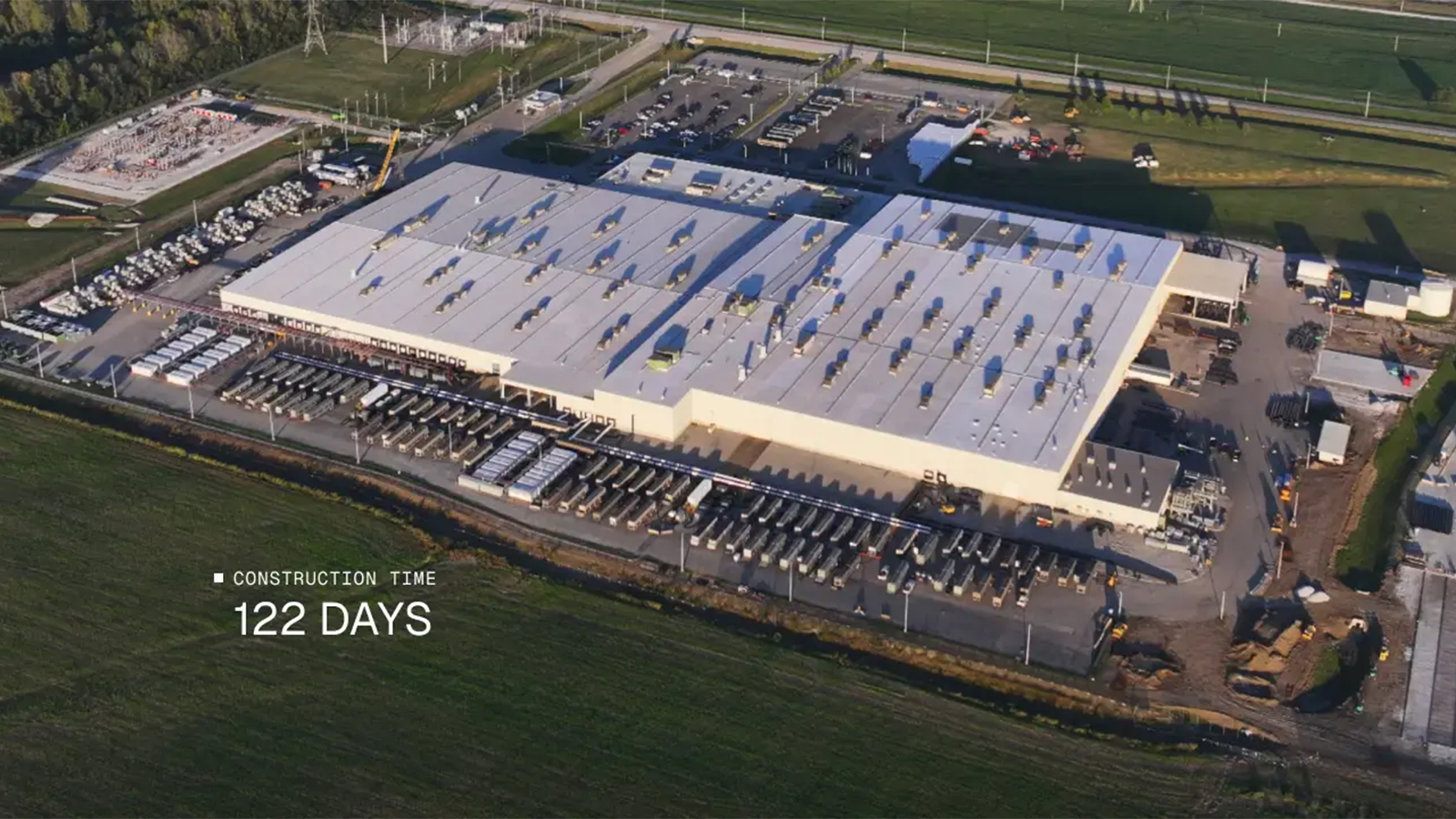
xAI launched in July 2023 and rapidly moved to infrastructure. By September 2024 it had opened Colossus I in a 300,000 sq ft converted Electrolux factory in Memphis. This facility initially housed 100,000 Nvidia H100 GPUs, deployed in just 19 days of rack installation. In total, the build—from shell retrofit to operational status—took only about 122 days. TVA (Tennessee Valley Authority) granted over 100 MW of grid power for Colossus I, and Tesla Megapack battery systems were installed to stabilise the load.
In March 2025 xAI purchased adjacent Memphis land for Colossus II, a 350 MW capacity hall that was commercially live by January 2026. Musk claimed 1 GW for Colossus II, but satellite estimates show around 350 MW cooling capacity. By late 2025 and early 2026, xAI announced a third building (code-named MACROHARDRR) in Southaven, Mississippi. This 312,000 sq ft facility is being retrofitted and is expected online by February 2026. Altogether, xAI’s three data halls will approach 2 GW of compute power.
Key speed enablers included re-using existing structures and parallelized build/testing. xAI skipped some traditional staging: GPU racks went live 19 days after arrival, and new racks were rolling in continuously. Power was provisioned via on-site gas turbines and batteries rather than waiting for full grid upgrades. However, the company later sought formal permits for the turbines.
Capital & Fundraising
xAI’s capitalisation has been as extraordinary as its build pace. Key known funding rounds are summarized below:
| Date | Round | Amount | Lead Investors / Notes | Implied Valuation |
|---|---|---|---|---|
| May 2024 | Series B | $6 billion | Valor Equity, Vy Capital, a16z, Sequoia, Fidelity, Kingdom Holding (Saudi) | Not disclosed |
| July 2025 | Series D | $5 billion | SpaceX ($2 billion from SpaceX); part of merger with X (xAI + X at $113B) | About $113 billion post-merger |
| January 2026 | Series E | $20 billion | Valor, StepStone, Fidelity, Qatar Investment, MGX, Baron Capital; strategic investors: NVIDIA, Cisco | More than $230 billion |
xAI’s Series E exceeded a $15 billion goal and pulled in $20 billion. Earlier financing included about $10 billion of debt and equity in 2025 and multiple smaller pre-Series B rounds that were not publicly disclosed. Elon Musk also merged xAI into his X social network in March 2025 and later into SpaceX in February 2026, though these were intra-Musk restructurings rather than third-party raises.
Use of proceeds is focused on compute infrastructure and R&D. The Series E release explicitly ties funds to compute infrastructure and infrastructure buildout, while reporting also noted bulk spending on GPUs. xAI reports about 1 million H100-equivalent GPUs across Colossus I and II by the end of 2025. There were also plans to raise more capital to double Colossus’s GPUs from 100,000 to 200,000, showing repeated targeted fundraising for capacity expansion. Some state incentives were also secured as part of the Mississippi project.
Overall, xAI’s funding has been exceptionally large and fast: roughly $35–40 billion in cash equity over 2024 to early 2026, with valuations reportedly soaring from around $80 billion to over $200 billion. By comparison, other AI startups have generally raised far less. xAI’s approach—attracting sovereign wealth funds, tech giants, and support from Musk’s other companies—reflects an aggressive capital strategy built to match its construction speed.
| Round | Date | Amount Raised | Lead / Notable Investors | Valuation (post-money) | Notes / Use of Proceeds |
|---|---|---|---|---|---|
| Series B | 2024-05 | $6.0 billion | Valor, Vy, A16Z, Sequoia, Fidelity, Kingdom (Prince Alwaleed) | n/a | Infrastructure and R&D |
| Series D | 2025-07 | About $5.0 billion | SpaceX ($2 billion) plus others | About $113 billion (combined with X) | Compute expansion, especially GPUs |
| Series E | 2026-01 | $20.0 billion | Valor, StepStone, Fidelity, QIA, MGX, Baron; strategic investors: NVIDIA, Cisco | About $230 billion | Data-centre buildout, GPUs, and AI R&D |
Operational Scaling & Growth Metrics
By early 2026, xAI’s Colossus supercomputers were among the world’s largest. Colossus I and II combined house roughly 1–1.5 million GPUs (H100 and Blackwell), delivering on the company’s claim of more than one million H100 GPU equivalents. This implies raw power on the order of 500–600 MW before cooling overhead. Industry modeling indicates a 1 million GPU cluster can draw about 1.4–2.0 GW including PUE. xAI is poised to reach around 2 GW total capacity with MACROHARDRR.
Public data on rack count, PUE, or occupancy is limited, but some trends are inferable. The Colossus facilities use immersion and conventional cooling, likely yielding a PUE in the 1.2–1.5 range, which is typical for AI warehouses. xAI’s reported 600 million monthly active users across Grok and X suggests heavy app usage, but revenue and contract disclosures remain limited. Organizationally, xAI is hiring aggressively, and local economic development organisations have even created dedicated teams to support the expansion.
In short, xAI has achieved massive scale in hardware—multi-hundred-thousand GPU clusters—at near-full target utilization for model training, but its energy requirements, infrastructure costs, and regulatory hurdles remain central to the story.
| Metric | Colossus I (Memphis) | Colossus II (Memphis) | MACROHARDRR (Southaven) | Notes / Benchmark |
|---|---|---|---|---|
| GPUs (approx) | 100,000 → 200,000+ | Additional 150,000? | Toward 1,000,000 total | 100k at launch; later plans to double capacity |
| Compute (racks) | 3,000+ GPUs/rack × about 60–70 racks | Similar scale | Larger expansion | 8-GPU servers × about 125k predicted in broader buildout estimates |
| Power (cooling cap.) | About 300 MW | About 350 MW | Expanding toward 2 GW | Musk’s 1 GW claim for Colossus II appears aspirational |
| PUE | About 1.2–1.4 (estimate) | About 1.2–1.4 (estimate) | Unknown | Modern AI centers often target about 1.2; overhead can add 30–50% |
| Occupancy / Utilization | About 100% (training mode) | About 100% (training) | – | Capacity appears dedicated to Grok / AI workloads |
| Monthly Users (Grok/X) | – | – | About 600 million total | Across Grok chatbot experiences in apps and vehicles |
Regulatory, Environmental & Community Impacts
xAI’s rapid buildout has collided with environmental and community concerns. The biggest issue has been unpermitted gas turbines. To feed Colossus II before grid power was ready, xAI installed dozens of temporary gas generators in Southaven, Mississippi, without permits. In February and March 2026, Mississippi regulators approved a permit for 41 new turbines to replace unpermitted ones.
Community activists and legal groups have threatened action, arguing that xAI violated the Clean Air Act by operating the equivalent of a power plant with heavy NOx emissions. Protesters at hearings objected to noise, emissions, and health risks. The approved permit requires pollution controls, emissions modeling, and related compliance measures. xAI has publicly committed to meeting applicable air quality standards.
Grid connections are also under development. TVA approved more than 100 MW to Memphis, and xAI has considered massive new gas-fired plants and even shipping in foreign power plant modules for later phases. Little has been disclosed about renewable energy integration or cooling-water impacts, and the reliance on gas implies a high carbon footprint.
On the positive side, governments have offered strong incentives. Mississippi granted long-term sales tax exemptions on data-centre equipment, and local officials have described the project as the largest economic development project in the state’s history. The Memphis Chamber gave xAI concierge-style support, explicitly framing “power and velocity” as part of the region’s appeal. Still, community trust remains strained, with some residents saying xAI’s promises to be good neighbors ring hollow.
Competitive & Market Context
xAI’s expansion is taking place amid unprecedented demand for AI compute. Global hyperscalers such as Google, Microsoft, AWS, and Meta are spending more than $200 billion in 2024 on datacenter capital expenditures. OpenAI has announced multi-gigawatt Stargate facilities, and Anthropic has also secured major backing. In that context, xAI’s target of around 2 GW is impressive, even if it remains smaller than the combined hyperscale buildout of major cloud providers.
Memphis and Southaven offer several advantages: comparatively low grid costs, strong logistics, and generous tax incentives. Environmental and labor regulations are also looser than in some rival markets, which can accelerate approvals. Competitors, by contrast, are building across Indiana, Georgia, Virginia, Utah, and abroad, often facing slower grid and permitting processes. Industry analysts increasingly note that every AI infrastructure strategy now hinges on access to power.
On pricing and customers, Grok has largely been distributed through X and related Musk platforms rather than through a traditional enterprise sales model. Revenue metrics remain limited. At the same time, the market remains supply-constrained, especially for advanced GPUs. xAI’s large pre-orders and strategic ties with NVIDIA help it secure hardware, but only by pairing infrastructure ambition with exceptionally large fundraising.
In summary, xAI’s rapid build is an outlier even among AI giants. It leapfrogs some normal hurdles through vertical integration and Musk’s broader ecosystem, but also inherits sharp community and regulatory pushback. Its trajectory illustrates the broader reality that AI is now as much an infrastructure and power race as it is a software race.
Key Takeaways & Recommendations
- Begin with existing infrastructure and modular design. Grok’s Colossus reused a 300,000 sq ft factory, saving years versus a greenfield build. Rapid GPU deployment and standardised rack and cooling modules kept construction agile. Prefer retrofits or pre-engineered modules, and stage hardware installation in parallel with the core build.
- Ensure power ahead of schedule. xAI sidestepped grid delays with on-site gas turbines and Tesla batteries. The approach was controversial, but it underscores the importance of early energy planning. Secure temporary or distributed energy before lock-in, and consider diversified sources.
- Aggressive but coordinated permitting. xAI moved before all permits were fully in place, which cut time but also triggered legal risk. Engage regulators early to fast-track critical approvals while also investing in pollution controls and community outreach from the beginning.
- Leverage local incentives and partners. Mississippi tax treatment and Memphis’s support team reduced costs and friction. Strategic investors such as NVIDIA and Cisco also brought supply-chain advantages. Aggressively negotiate state and local incentives and align with technology suppliers where possible.
- Fundraise boldly, invest wisely. Raising more than $30 billion gave Grok unmatched scale, but it also raised expectations. Secure a diversified funding pipeline well before buildout, earmark proceeds clearly for infrastructure, and maintain milestone discipline.
- Balance speed with sustainability. Grok’s approach favored speed, but environmental concerns could translate into fines, delays, or reputational damage. Integrate sustainability early through cleaner power sourcing, efficient cooling, and compliance planning.
- Prepare for community relations. The Southaven experience shows that local resistance can threaten timelines. Proactive engagement, transparent studies, local liaisons, and real-time monitoring can materially reduce opposition risk.
By combining modular construction, pre-arranged power, accelerated permitting with risk controls, strong local partnerships, and massive targeted fundraising, a new data-centre project can emulate some of Grok’s velocity while avoiding its biggest pitfalls. Together, these practices enabled xAI to move from zero to a multi-gigawatt AI infrastructure platform in under two years.
Comments (0)